Yoga for Martial Artists: Flexibility, Recovery, and Injury Prevention
Yoga routines designed for martial artists. Improve hip flexibility, shoulder mobility, and recovery between training sessions.
Most fighters think of yoga as something for people who don’t fight. That bias costs them flexibility, recovery capacity, and career longevity. The fighters who integrate yoga consistently — not once in a while when something hurts, but as a regular training component — move better, recover faster, and train longer into their careers than those who don’t.
This isn’t about becoming a yoga instructor. It’s about using yoga as a tool to support the physical demands of martial arts training.
Why Fighters Need Yoga (Specifically)
Martial arts create specific physical imbalances. Striking tightens the hip flexors and shoulders. Grappling compresses the spine and rounds the upper back. Heavy bag work shortens the pectorals. Repeated takedown drilling strains the lower back.
Yoga addresses every one of these patterns through poses that open the exact areas martial arts tighten. It’s not a coincidence — the biomechanical demands of fighting and the corrective benefits of yoga are nearly perfect opposites.
Hip Flexibility
Your hips are the central engine for every martial arts technique. Kicks generate power from hip rotation. Guard retention in BJJ requires hip mobility in multiple planes. Takedown defense depends on hip drop and sprawl range. Tight hips limit all of these.
Yoga develops hip flexibility through ranges of motion that static stretching can’t match. Poses like pigeon, lizard, and deep lunges open the hip flexors, external rotators, and adductors simultaneously — the three muscle groups that fighters tighten fastest.
Shoulder Mobility
Grapplers develop chronically tight shoulders from constantly pulling, framing, and gripping. Strikers develop forward-rounded shoulders from holding guard position for thousands of rounds. Both patterns reduce overhead mobility and increase rotator cuff vulnerability.
Yoga opens the chest, stretches the lats, and strengthens the posterior shoulder in positions that combat training neglects. Poses like thread-the-needle, puppy pose, and eagle arms directly counteract grappling-specific shoulder tightness.
Spinal Health
The spine takes a beating in combat sports. Repeated takedowns, stacking during guard passes, and twisting during scrambles compress the vertebral discs. Yoga decompresses the spine through gentle twists, forward folds, and extension poses that create space between vertebrae and hydrate the discs.
Active Recovery
Hard training creates systemic inflammation, elevated cortisol, and nervous system fatigue. Gentle yoga on rest days promotes blood flow without adding training stress, activates the parasympathetic nervous system (the “rest and digest” mode), and reduces cortisol levels. This is recovery, not additional training volume.
The Fighter’s Yoga Routine: 3 Sessions Per Week
Session 1: Full-Body Flow (45-60 minutes, rest day)
This is your primary yoga session. Do it on a rest day when your body needs recovery, not additional load.
Warm-Up (5 minutes):
- Cat-Cow: 10 repetitions, moving slowly with breath. Inhale on cow (arch), exhale on cat (round). This mobilizes the entire spine.
- Downward Dog: Hold for 5 breaths. Pedal your heels alternately to stretch calves and hamstrings.
Standing Sequence (15 minutes):
- Warrior I (Virabhadrasana I): Hold 5 breaths each side. Stretches hip flexors, strengthens quads. Keep your back heel grounded and your hips squared forward.
- Warrior II (Virabhadrasana II): Hold 5 breaths each side. Opens the hips into external rotation while building isometric leg strength.
- Triangle (Trikonasana): Hold 5 breaths each side. Stretches the hamstrings and obliques. Don’t collapse your chest toward the floor — rotate the torso open.
- Extended Side Angle (Utthita Parsvakonasana): Hold 5 breaths each side. Deep lateral stretch through the entire side body, hip opener for the front leg.
Hip-Opening Sequence (15 minutes):
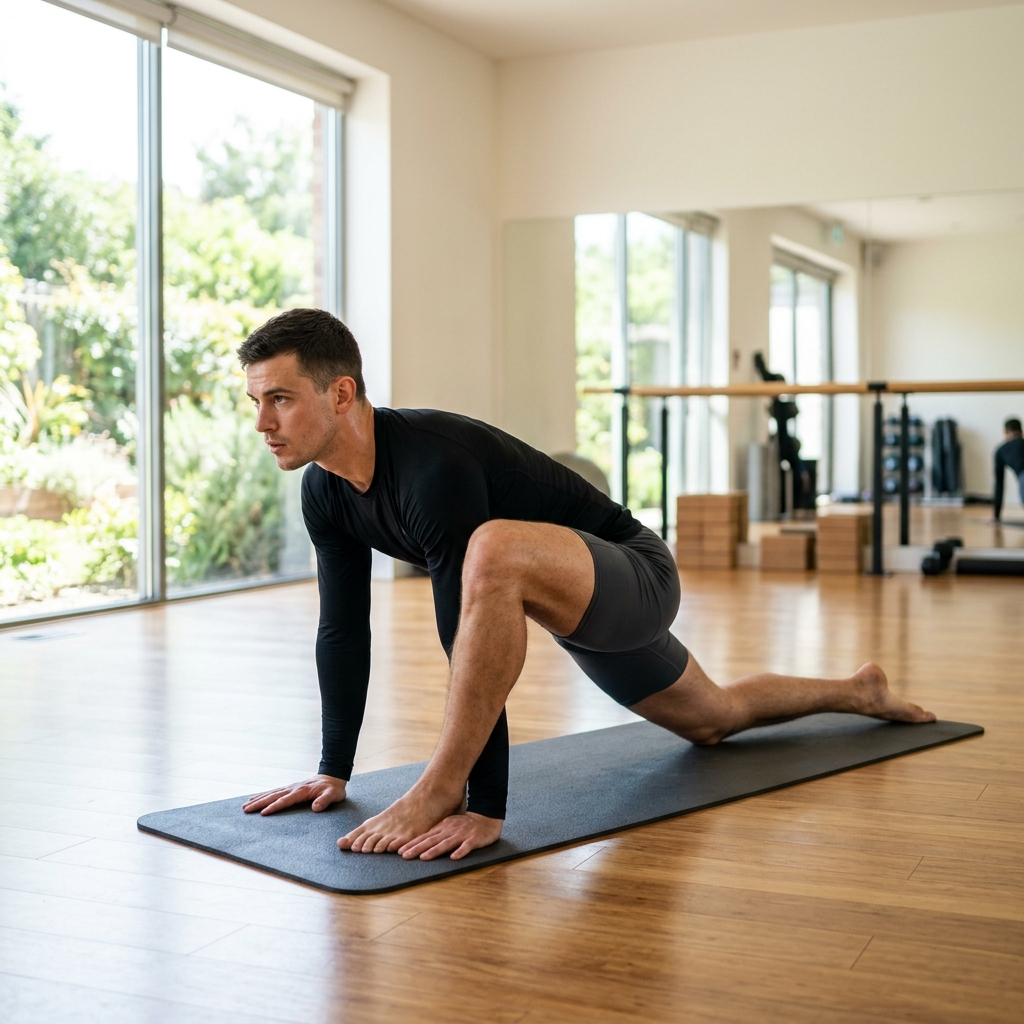
- Low Lunge (Anjaneyasana): Hold 8 breaths each side. The primary hip flexor stretch for fighters. Sink your hips forward and down. Squeeze the glute of the back leg to deepen the stretch.
- Pigeon Pose (Eka Pada Rajakapotasana): Hold 10 breaths each side. The single most valuable yoga pose for martial artists. Opens the piriformis and external hip rotators that tighten from kicking and grappling. If your hips are very tight, place a block or folded towel under the front hip.
- Lizard Pose (Utthan Pristhasana): Hold 8 breaths each side. Deeper hip flexor stretch with an inner thigh component. Drop to forearms if your flexibility allows.
- Happy Baby (Ananda Balasana): Hold 10 breaths. Opens the hips, inner thighs, and decompresses the lower back simultaneously.
Floor Sequence (10 minutes):
- Supine Twist: Hold 8 breaths each side. Decompresses the spine after training. Let gravity do the work — don’t force the twist.
- Bridge Pose: Hold 5 breaths, repeat 3 times. Opens the chest, stretches hip flexors, strengthens glutes. Counteracts forward-rounded posture.
- Legs Up the Wall (Viparita Karani): Hold 3-5 minutes. Promotes venous return from the legs, reduces swelling in feet and ankles after training. This is one of the best recovery positions available.
Cool-Down (5 minutes):
- Seated Forward Fold: Hold 10 breaths. Gentle hamstring stretch and spinal decompression.
- Savasana (Corpse Pose): 3-5 minutes. Full relaxation. Focus on slow, diaphragmatic breathing. This activates parasympathetic recovery.
Session 2: Hip-Focused Quick Flow (20 minutes, after lower body training)
Use this session after leg-heavy training days — sparring with lots of kicks, wrestling practice, or leg-focused conditioning.
- Cat-Cow: 8 reps
- Downward Dog to Low Lunge: Alternate sides, 3 reps each
- Pigeon Pose: 2 minutes each side
- Half Splits (Ardha Hanumanasana): 90 seconds each side. Straighten the front leg from low lunge position for a deep hamstring stretch.
- Frog Pose (Mandukasana): 2 minutes. Opens the inner thighs and groin. Start gentle — this pose is intense for tight hips.
- Supine Twist: 90 seconds each side
- Happy Baby: 2 minutes
Session 3: Upper Body and Spine (20 minutes, after grappling)
Use this session after grappling-heavy days when your shoulders, upper back, and neck are tight.
- Cat-Cow: 8 reps
- Thread the Needle: 90 seconds each side. From tabletop, reach one arm under your body and lower that shoulder to the ground. This opens the posterior shoulder and mid-back.
- Puppy Pose (Uttana Shishosana): 2 minutes. Like child’s pose but with hips stacked over knees and arms extended forward. Stretches the lats, chest, and shoulders.
- Eagle Arms (Garudasana arms only): 90 seconds each side. Seated or standing. Wraps the arms to stretch between the shoulder blades — the exact area that tightens during grappling.
- Cobra Pose (Bhujangasana): Hold 5 breaths, repeat 3 times. Opens the chest and stretches the anterior shoulder. Keep your elbows close to your body.
- Supine Chest Opener: Lie on a foam roller placed lengthwise along your spine. Arms out to the sides. Hold 3 minutes. Gravity opens the chest and counteracts forward-rounded posture.
- Neck Stretches: Gentle lateral neck tilts, 30 seconds each side. Don’t force — cervical spine stretches should be gentle.
Equipment for Yoga (Minimal Setup)
You don’t need much:
| Item | Why | Recommended | Price |
|---|---|---|---|
| Yoga mat | Cushioning and grip | Manduka PROlite | ~$80 |
| Yoga blocks (2) | Support for tight areas | Gaiam Cork Blocks | ~$15 |
| Yoga strap | Assists hamstring and shoulder stretches | Clever Yoga Strap | ~$10 |
Gaiam Cork Yoga Blocks on Amazon →
A good yoga mat matters more than you’d think. Training on a cheap, slippery mat means your focus goes to maintaining grip instead of the stretch. Cork or rubber mats with adequate thickness (5mm+) provide the traction and cushioning you need.
Common Mistakes Fighters Make with Yoga
Going too hard. Yoga isn’t training — it’s recovery and maintenance. If you’re muscling into poses, shaking with effort, and sweating heavily, you’re working too hard. Ease into positions and let gravity and breathing do the work.
Skipping it when “too sore.” The days when you feel most sore are often when yoga provides the most benefit. Light movement and gentle stretching promote blood flow that accelerates recovery. Don’t push into pain, but don’t avoid the mat entirely because you’re stiff.
Only doing yoga when injured. Yoga’s greatest value is preventing injuries, not treating them. Waiting until something hurts to start a yoga practice means you missed months of preventive benefit. Build it into your weekly schedule as a non-negotiable.
Comparing yourself to the yoga instructor. Fighters often have extremely tight hips, shoulders, and hamstrings compared to regular yoga practitioners. Your pigeon pose will look nothing like the instructor’s for a long time. That’s fine. Work within your current range and trust that it will improve with consistency.
Neglecting breathing. The breathing component of yoga is not decoration. Slow, controlled diaphragmatic breathing activates parasympathetic recovery, reduces cortisol, and teaches breath control that transfers directly to fight cardio. Breathe through the nose when possible, and coordinate breath with movement.