Heavy Bag Workout for Beginners: 20-Minute Routine
A 20-minute heavy bag workout for beginners. Step-by-step rounds covering jabs, crosses, hooks, and kicks with rest intervals and form tips.
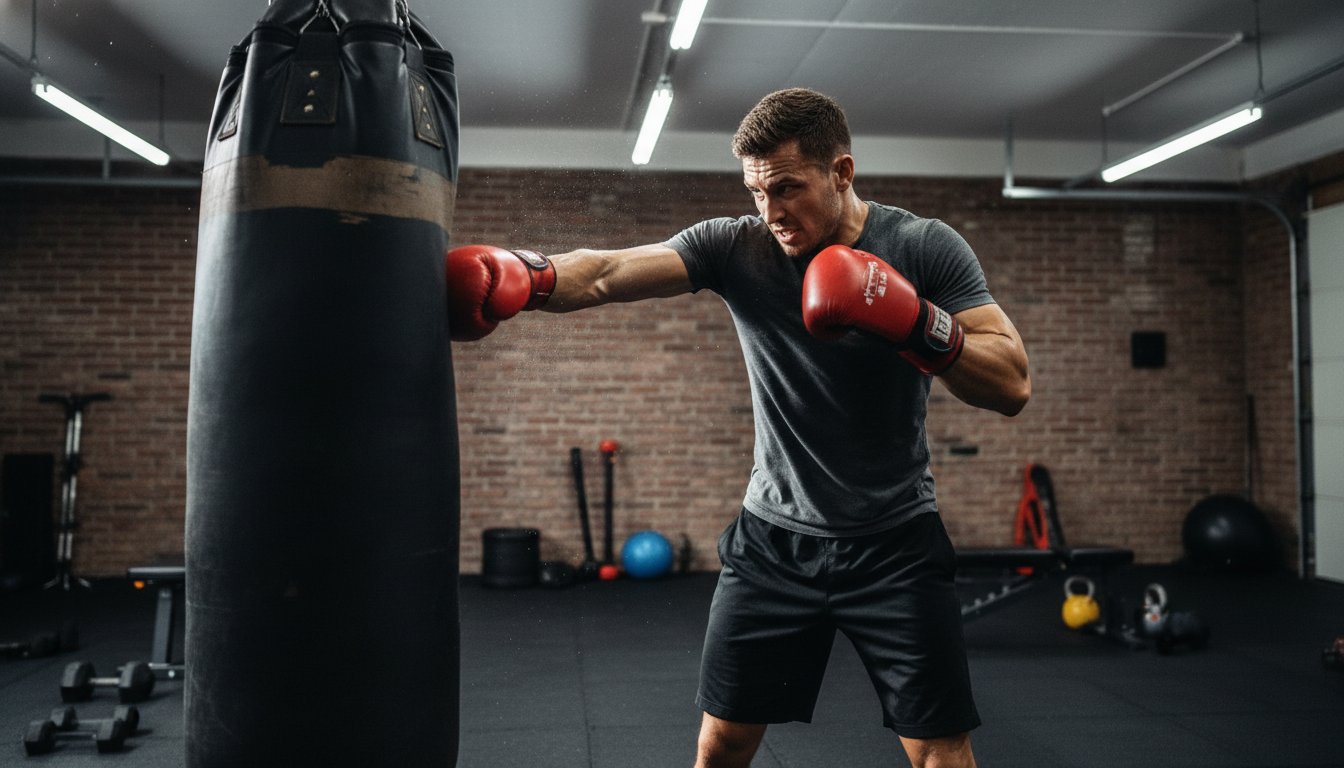
This heavy bag workout for beginners is a structured 20-minute routine that builds striking fundamentals while giving you a serious cardio session. The routine uses timed rounds with rest intervals, starting with basic punches and progressing to combinations. You do not need prior experience, each round includes form guidance so you can hit the bag correctly from the start.
ViralCombatTV is an editorial desk. We compile community consensus, manufacturer spec sheets, and published coaching sources. We do not run an in-house lab or a test fleet. The notes below are a research-desk read of timed beginner bag rounds — not a garage-session diary.
Unique angle here: this is the timed 20-minute interval session, not the combination-library desk. Keep both URLs: Heavy Bag Drills and Combinations for Beginners. Stance and guard live on Boxing Stance and Footwork Fundamentals. Live rounds are a different problem — How to Spar Safely as a Beginner. Rest days sit on Recovery for Combat Athletes. If you also roll, start with BJJ White Belt Survival Guide.
Price ranges below are research snapshots from public listings, not live offers.
TL;DR: The 20-Minute Routine
| Round | Duration | Focus | Rest |
|---|---|---|---|
| Warm-up | 3 min | Shadow boxing, light movement | 30 sec |
| Round 1 | 2 min | Jab and cross | 30 sec |
| Round 2 | 2 min | Hooks and uppercuts | 30 sec |
| Round 3 | 2 min | 3-punch combinations | 30 sec |
| Round 4 | 2 min | Body shots | 30 sec |
| Round 5 | 2 min | Power shots | 30 sec |
| Round 6 | 2 min | Free round, all strikes | 30 sec |
| Cooldown | 3 min | Light jabs, stretching | , |
Total time: 20 minutes
What You Need Before Starting
Equipment
- Heavy bag (70-100 lbs for most adults). A bag mounted from the ceiling or on a stand both work. Freestanding bags with a water-filled base are less stable but adequate for beginners.
- Boxing gloves (14-16oz). See our guide on best boxing gloves for beginners for specific recommendations.
- Hand wraps (180-inch semi-elastic). Absolutely mandatory. Hand wraps protect the small bones in your hand and wrist that gloves alone do not cover.
- Timer. A round timer app on your phone works. Set it for 2-minute rounds with 30-second rest periods.
Listing check (beginner bag session): confirm 14-16oz gloves and 180-inch wraps are on before the first jab, and that the bag is hung or base-filled enough that a 2-minute jab-cross round does not walk the stand across the floor — bare-fist clips and MMA-glove bag rounds share the same “just hit it” search card.
Space
You need about 6 feet of clear space around the bag. Enough room to circle the bag, step back from it, and throw strikes from different angles without hitting walls or furniture.
Proper Form: The Basics
Before starting the rounds, understand the fundamental strikes you will use:
Jab
Your lead-hand straight punch. From your guard, extend your lead hand straight toward the bag, rotating your fist so the palm faces down at full extension. Snap the hand back to your guard immediately. The jab is a fast, light punch, do not try to knock the bag off its chain.
Cross
Your rear-hand straight punch. Drive your rear hand straight toward the bag while rotating your rear hip and pivoting on your rear foot. The power comes from the hip rotation, not the arm. Your rear shoulder should end up near your chin at full extension.
Lead Hook
Your lead-hand hook punch. Turn your lead foot, rotate your hips, and carry your lead arm in a tight arc toward the side of the bag. Your elbow stays bent at approximately 90 degrees throughout. The fist position can be horizontal (palm down) or vertical (thumb up), use whatever feels natural.
Rear Hook
Same mechanics as the lead hook but with the rear hand. The rear hook has more power because it involves a larger hip rotation, but it also has a longer travel time.
Uppercut
A short, upward punch thrown from close range. Drop your knees slightly, then drive upward with your fist while rotating your hip. The punch travels upward into the underside of the bag. Keep the arc short, an uppercut is not a scoop, it is a short upward drive.
The 20-Minute Routine
Warm-Up (3 Minutes)
Shadow box at 50% intensity for 3 minutes. The goal is to get your heart rate up, loosen your joints, and practice your stance and movement before you touch the bag.
- 1 minute: Bounce in your stance, throw light jabs at the air
- 1 minute: Add crosses, move forward and backward
- 1 minute: Add hooks and body movement (slips, rolls)
Keep your hands up and your chin down even during the warm-up. Building good habits starts before you touch the bag.
Round 1: Jab and Cross (2 Minutes)
Focus on the two most fundamental punches in striking. This round is about form, not power.
Pattern:
- Jab (x3)
- Cross (x3)
- Jab-Cross combination (x3)
- Move laterally around the bag
- Repeat
Form reminders:
- Return your hand to your guard after every punch. The most common beginner mistake is leaving the hand out after the punch.
- Aim for the center of the bag at head height.
- Breathe out sharply with each punch. Holding your breath kills your cardio within a round.
- Stay on the balls of your feet. Flat feet slow your movement.
Rest: 30 seconds. Shake out your hands, catch your breath, stay moving.
Round 2: Hooks and Uppercuts (2 Minutes)
This round focuses on the punches that require more hip rotation and shorter range.
Pattern:
- Lead hook (x3)
- Rear hook (x3)
- Lead uppercut (x3)
- Rear uppercut (x3)
- Move laterally, throw a hook-uppercut combination
- Repeat
Form reminders:
- Hooks are compact. If your arm is swinging wide, you are looping instead of hooking. Keep the elbow at 90 degrees.
- Uppercuts start from your guard position. Drop your knees slightly, then drive upward. Do not wind up by dropping your hand first.
- Stay close enough to the bag that your hooks and uppercuts make solid contact. If you are at jab range, hooks miss or land with the forearm.
Rest: 30 seconds.
Round 3: Three-Punch Combinations (2 Minutes)
Now you combine the punches from rounds 1 and 2 into flowing combinations.
Combinations to use:
- Jab - Cross - Lead Hook
- Jab - Rear Uppercut - Lead Hook
- Cross - Lead Hook - Cross
- Jab - Cross - Lead Hook to Body
Pattern:
- Pick one combination and throw it 3 times
- Move laterally
- Switch to the next combination
- Repeat through all four
Form reminders:
- Combinations should flow without pauses between punches. Each punch sets up the next.
- Keep your non-punching hand at your guard. Beginners often drop the free hand during combinations.
- Maintain your stance between combinations. Do not lean into the bag.
Rest: 30 seconds.
Round 4: Body Shots (2 Minutes)
Punching the bag at body height forces you to change levels, which works your legs and core.
Pattern:
- Jab to head, cross to body (x3)
- Lead hook to body, rear hook to body (x3)
- Jab to head, cross to head, lead hook to body (x3)
- Move laterally
- Repeat
Form reminders:
- Bend your knees to change levels, do not just drop your hands and punch low. Your whole body should lower.
- Body hooks make contact with the fist horizontal or slightly angled. Aim for the side of the bag.
- The transition from head strikes to body strikes should involve your legs, not just your arms changing height.
Rest: 30 seconds.
Round 5: Power Shots (2 Minutes)
This round is about generating maximum force on each punch. Slow down and focus on mechanics.
Pattern:
- Step in with a hard cross (x3). Full hip rotation, plant your feet, drive through the bag.
- Step in with a hard lead hook (x3).
- Hard rear uppercut (x3).
- Move and reset between each power shot.
Form reminders:
- Power shots start from the ground. Push off your rear foot, rotate your hips, and transfer that force through your torso and into your arm.
- Do not sacrifice form for power. A mechanically correct medium-power punch generates more force than an all-out sloppy swing.
- Breathe out forcefully with each shot.
- Reset your stance completely between power shots. Do not throw them from an unbalanced position.
Rest: 30 seconds.
Round 6: Free Round (2 Minutes)
Everything you have practiced goes into this round. Move around the bag, throw any combinations you want, mix head and body shots, and work at 80% effort.
Guidelines:
- Keep moving, circle the bag, step in and out, change angles.
- Throw combinations of 2-4 strikes, then move. Do not stand in front of the bag and throw 20 punches.
- Mix speed and power. Light jabs followed by a hard cross. Fast hooks followed by a slow uppercut.
- If you are gassed, slow down but keep your hands up and keep moving. Do not stop and stand still.
Rest: 30 seconds.
Cooldown (3 Minutes)
- 1 minute: Light, slow jabs and crosses at the bag. Barely touching it. Focus on form with zero power.
- 2 minutes: Step away from the bag. Stretch your shoulders, forearms, wrists, and hip flexors. Roll your neck gently. Shake out your hands.
How to Progress This Workout
Week 1-2: Focus on Form
Go at 50-60% intensity. Your goal is to learn the punches and combinations correctly. Speed and power come later. Film yourself if possible and compare your form to instructional videos.
Week 3-4: Increase Intensity
Bump up to 70-80% effort. Your punches should feel crisp and the bag should be moving. Your breathing should be hard at the end of each round but manageable during the rest period.
Week 5+: Add Volume
Once the 20-minute routine feels manageable, add rounds:
- Add a second “free round” at the end
- Increase round length from 2 minutes to 3 minutes
- Reduce rest periods from 30 seconds to 15 seconds
- Add kicks if you train Muay Thai or MMA (round kicks to the body/legs)
Common Beginner Mistakes
Punching Too Hard Too Soon
Your hands, wrists, and shoulders are not conditioned for heavy impact. Going all-out in your first session leads to soreness, injury, and poor form. Start at 50% power and build up over weeks.
Forgetting to Breathe
Exhale sharply with each punch. Beginners hold their breath during combinations, which causes rapid fatigue and lightheadedness. Make breathing a conscious practice for the first few weeks until it becomes automatic.
Standing in One Spot
The bag is not a wall. Move around it, step in and out, change angles. Standing still in front of the bag teaches you to fight flat-footed, which is a bad habit that is hard to break.
Dropping Your Guard
After every punch, your hand returns to your face. During every combination, your non-punching hand stays at your guard. This is the most important habit you can build from day one.
Gym vs Home, and When to Skip the Buy
A 20-minute interval is a programming problem, not a shopping list. The bag you already have access to is enough if gloves and wraps are on.
Gym bag nights: use the house bag. Buy wraps and 14-16oz gloves if the gym does not loan a dry pair. Then run this clock, not a combination encyclopedia — that library is Heavy Bag Drills and Combinations for Beginners.
Home stand or joist bag: skip a second bag if one 70–100 lb bag already sits in 6 feet of clear space. Spend the session on stance from Boxing Stance and Footwork Fundamentals and the rounds below. Rest the wrists the next day with Recovery for Combat Athletes.
When to skip the buy
- Skip a new hanging bag if your gym already has one you can book. The clock is the product.
- Skip 10oz “speed” or fashion MMA gloves for this routine. 14-16oz is the beginner impact stack.
- Skip a dedicated round timer if a phone interval app already runs 2:00 / 0:30.
- Skip adding this session on back-to-back days. Joints, not the Amazon cart, are the limiter.
This page does not add a shopping cart. Funding note for the rest of the desk: tagged Amazon links use viralcombattv-20 only. See How We Make Money.
FAQ
How heavy should a heavy bag be for beginners?
A good rule of thumb is to use a bag that weighs roughly half your body weight. For most adults, a 70-100 pound bag is appropriate. Lighter bags swing too much and heavier bags can be hard on your joints if your technique is not developed.
Can you do a heavy bag workout without gloves?
No. Always wear hand wraps and boxing gloves when hitting a heavy bag. Bare-fist bag work leads to skin tears, bruised knuckles, and wrist injuries. Even with good technique, the repetitive impact without padding is damaging.
How many times a week should I do heavy bag workouts?
Two to three times per week with at least one rest day between sessions. Heavy bag work stresses your joints, particularly your wrists, elbows, and shoulders. Beginners need recovery time to avoid overuse injuries.
Is a heavy bag workout good cardio?
Coaching write-ups treat a moderate 20-minute interval as solid mixed cardio. Public calorie charts often quote a research-snapshot band of roughly 200–350 calories depending on body weight and effort. Treat that as a listing-style range, not a lab measurement from this desk.
Can I use a heavy bag workout to learn how to fight?
A heavy bag develops conditioning, power, and punch mechanics, but it does not teach you timing, distance management, or defense. Those require a live training partner. Use the bag to build a foundation, then read How to Spar Safely as a Beginner before you add contact.