Creatine for Martial Arts: Before or After Training, and the Weight-Cut Question
Does creatine help or hurt weight-class fighters? Desk-research review of the evidence on timing, loading, water weight, and when to skip it.
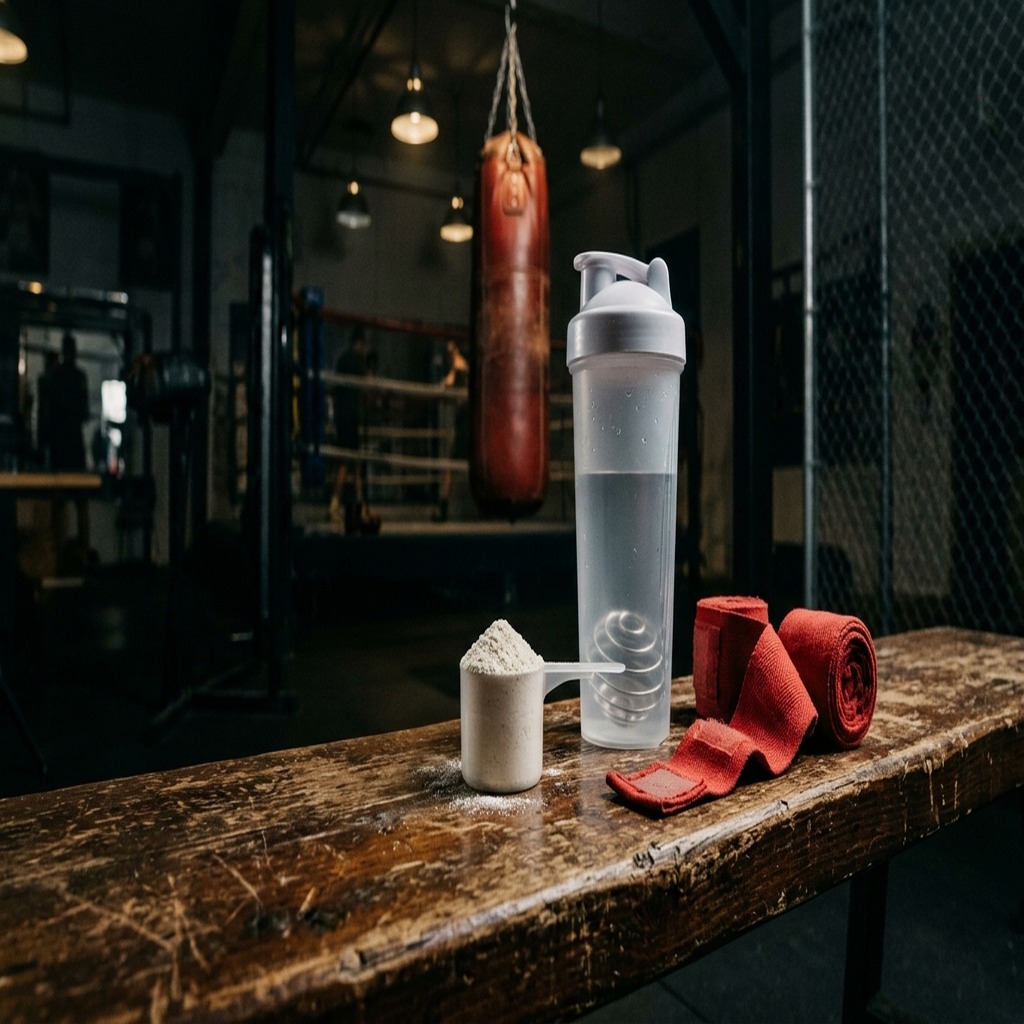
The honest answer to “creatine before or after training” is that timing barely matters, and the question fighters should actually be asking is whether the supplement fits a weight-class lifestyle at all. According to the International Society of Sports Nutrition (ISSN), creatine monohydrate is the most researched performance supplement in existence, with hundreds of studies supporting its effects on strength, power output, and training recovery. But martial artists sit in an awkward spot: the same supplement that helps you grind through rounds also holds water in your body, and your sport may require you to make a specific number on a scale.
This is a desk-research guide from the ViralCombatTV editorial desk. We compile ISSN position stands and published sports-science sources; we do not run an in-house lab, we do not blood-test athletes, and we are not your nutritionist. If you compete and manage your weight seriously, run supplement decisions past your coach or a sports nutritionist — that is not a disclaimer, it is the correct process.
What the Research Actually Supports
Strip away the marketing and the creatine evidence base is unusually clean for a supplement:
- Strength and power. Meta-analyses cited in the ISSN position stand put the average strength gain from creatine plus resistance training above training alone — on the order of roughly 8% better performance across studies, with bench press and squat work showing consistent improvements.
- Recovery between efforts. Creatine appears to help with repeated-bout performance — exactly the rounds-and-sets structure of fight training, where your second and third rounds need to look like your first.
- Training volume tolerance. Users generally manage more total work in a session, which compounds over a camp.
- Cognitive under stress. There is emerging research on sleep deprivation and cognitive performance, but it is early; we do not count it as settled.
What the research does not support: creatine as a fat cutter, creatine as a pre-workout stimulant (it is not a stimulant at all), and any acute effect you feel within an hour of taking it. Creatine works by saturating muscle stores over days and weeks. Nothing about it is fast-acting, which is exactly why the timing question has such a deflating answer.
Before or After? The Timing Question, Settled
The short version: ISSN concludes that daily consistency matters far more than clock position. A frequently cited study found a small edge for post-workout dosing over pre-workout, but the difference was modest and the practical takeaway from the research community is that both work.
What actually matters about timing for fighters:
- Take it daily, training or not. Saturation is the mechanism. Skipping rest days slowly drains the tank you spent weeks filling.
- Anchor it to something you already do. Post-training shake, breakfast, dinner — the routine that survives a fight camp is the one attached to an existing habit.
- With food is fine, maybe slightly better. Some evidence suggests insulin helps muscle uptake, so taking it with a carb-containing meal is a reasonable default, not a requirement.
- Do not double-dose on hard days. There is no acute benefit to extra scoops; there is a real chance of GI upset, which is a bad trade during camp.
If you want the stimulant-timing discussion — what to take 30 minutes before sparring — that is a different supplement class entirely and lives in our pre-workout guide. Creatine is the tortoise: slow, cumulative, boring, and effective.
Loading vs Daily Dosing
Two viable protocols, one clear preference for weight-class athletes:
| Protocol | Dose | Time to saturation | Notes |
|---|---|---|---|
| Loading | ~20g/day (4x5g) for 5-7 days, then 3-5g | ~1 week | Faster results, more upfront water shift, more GI complaints |
| Daily (no load) | 3-5g every day | ~3-4 weeks | Smoother water-weight curve, easier on the stomach |
For a jiu-jitsu competitor or boxer who watches the scale, the slow route wins: the end state is identical, and a gradual 1-2 kg water shift across a month is much easier to fold into your walking-weight management than the same shift landed in a single week. Loading makes sense mainly for athletes far from a competition who want the performance effect online quickly.
Optimum Nutrition Creatine Monohydrate on Amazon →
Buy plain creatine monohydrate — micronized if the gritty texture bothers you. HCL, ethyl ester, and buffered variants cost more and have not outperformed monohydrate in head-to-head research. Third-party testing (Informed Sport, NSF) matters for tested competitors, since contamination in unverified batches is the real doping risk.
The Weight-Cut Tension: Water Weight Reality
Here is the part generic creatine guides skip and combat athletes cannot afford to.
Creatine holds water inside muscle cells. Expect 1-2 kg (2-4 lbs) of scale weight in the first weeks. It is intracellular water, not subcutaneous bloat — but the weigh-in scale does not distinguish. If you compete in a class with a same-day weigh-in or a cut deeper than a few percent of body weight, that is real, accountable mass.
The honest framing of the trade:
- Year-round, off-camp: the benefits clearly outweigh the scale cost. Strength and recovery compound across training blocks.
- During camp, away from the cut: most fighters continue; the water weight stabilizes after the first weeks and folds into walking weight.
- Final 1-2 weeks before weigh-in: this is where the consensus gets practical — if the cut is tight, stop. The performance benefits decay over weeks, not days, so a two-week stop costs little strength, while every retained kilogram makes the cut harder. Our weight-cutting guide covers the actual cut protocol, and the nutrition side lives in fighter nutrition for weight cutting.
- After weigh-ins: restart immediately. With a normal daily dose you re-saturate over a couple of weeks; some athletes use a short loading block here, which is one of the few places loading genuinely fits a combat schedule.
One more honest note: if your weight class is decided by fractions of a kilogram, this entire conversation is one to have with your coach and a sports nutritionist, not with a website. Individual sweat rates and cut sensitivity vary too much for one-size answers.
When to Skip Creatine Entirely
- You are actively cutting weight right now. Adding a water-retaining supplement mid-cut is working against yourself.
- Your walk-around weight is already over your class ceiling. Fix the diet side first — the fighter’s diet plan is the higher-leverage page for you.
- You have existing kidney conditions or take relevant medication. Healthy people tolerate creatine well across the long-term studies, but pre-existing renal issues are the standard contraindication — a doctor question, not a gym-bro question.
- You are inconsistent about taking it. A half-saturated tank delivers little; save the money until your routine supports a daily habit.
- You expected it to feel like a stimulant. It will not. For session-by-session energy, the pre-workout guide covers that supplement class, and for the adaptation side, recovery between training sessions is the bigger lever.
The Bottom Line
Creatine is one of the few supplements with an evidence base strong enough to recommend to almost any strength-training athlete — and martial artists are strength-training athletes with a scheduling problem. Take 3-5g of monohydrate daily, post-training or with a meal, skip the loading phase unless you are far from competition, and manage the known water-weight cost around your weigh-in calendar the same way you manage any other input: with a plan, not a panic.